Best Payroll Software Philippines: A CXO Buyer's Guide to 8 Platforms
Which payroll software best handles SSS, PhilHealth, Pag-IBIG, BIR, and 13th-month pay at enterprise scale? Here is how eight leading platforms stack up.
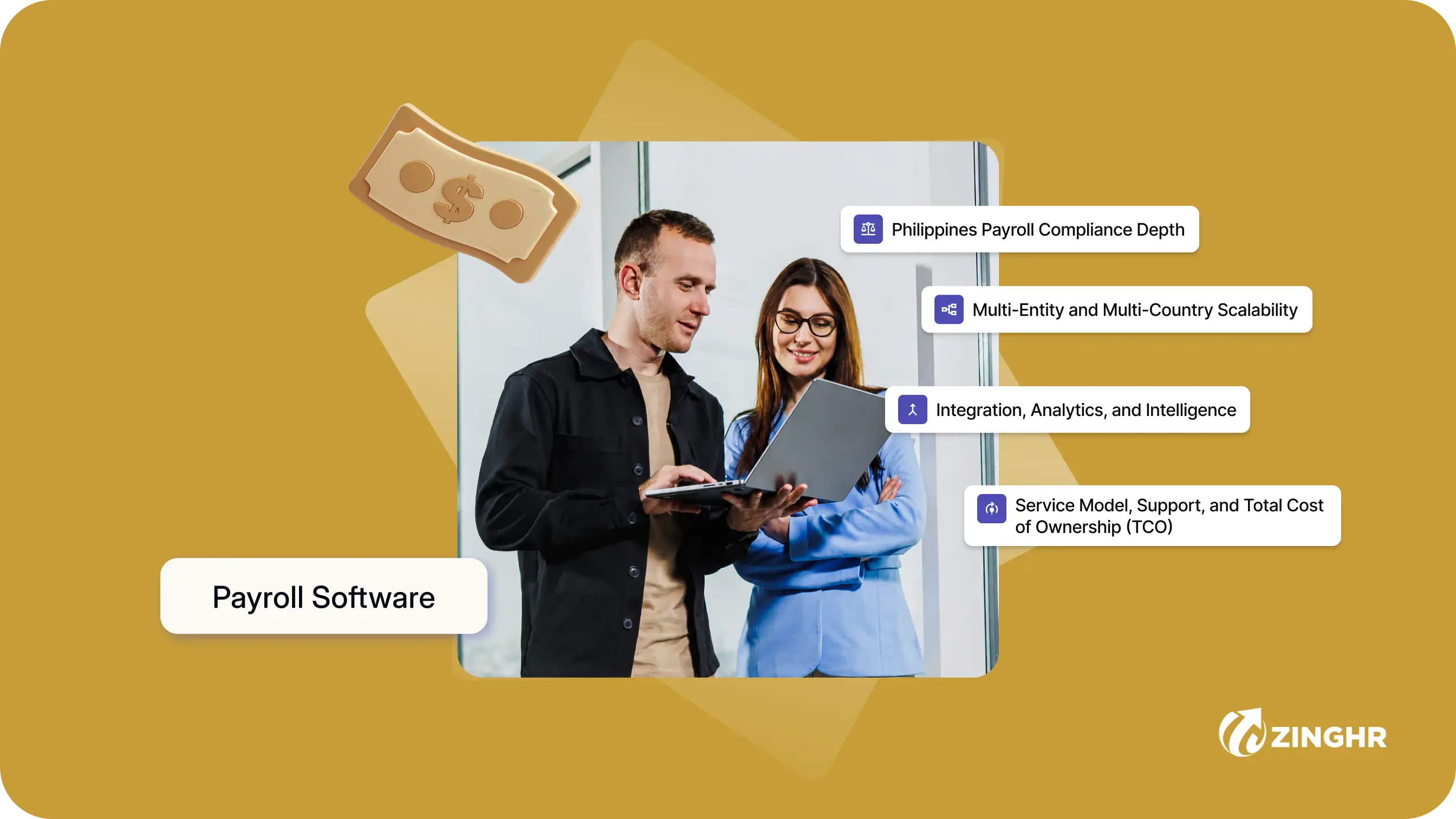
Table of contents
One unstitched HR platform to manage your entire workforce, from Hire to Re-Hire.
Talent Management solutions built for growing and exceptional people
Built-in compliance tools that update with changing regulations
Automated payroll, attendance, and leave management
Insights that help HR leaders make faster, better decisions

Key Takeaways
- The best Philippine payroll platform handles Social Security System (SSS), Philippine Health Insurance Corporation (PhilHealth), Home Development Mutual Fund (Pag-IBIG), Bureau of Internal Revenue (BIR) withholding, 13th-month pay, and night differentials automatically, with clean reconciliation every cycle.
- Multi-entity and multi-country support separates enterprise-grade tools. Groups with several legal entities soon outgrow single-country systems.
- ZingHR is the fastest growing HCM and payroll platform in the Philippines, built for the Philippine market with native, DOLE-compliant payroll and a local Centre of Excellence. Fully managed zero-tap payroll pairs with an agentic intelligence layer, giving boards real-time visibility into workforce cost, productivity, and compliance from one command centre.
- Global suites offer ERP integration at a higher total cost of ownership, and typically deliver Philippine payroll through partners rather than natively. Platforms built for the market handle statutory processing in-house.
- Match the platform to your operating model. Lean HR teams favour managed payroll services, while strong internal HR and IT teams can run highly configurable suites.
Running payroll with the right payroll system software in the Philippines means SSS, PhilHealth, Pag-IBIG, BIR withholding, 13th-month pay, and night differentials reconciling correctly every single cycle.
At 1,000+ headcount, a single misconfigured rule touches hundreds of payslips simultaneously.
The guide compares eight platforms against that reality. Each tool is judged on compliance depth, multi-entity scalability, integration, analytics, service model, and total cost of ownership, so you can shortlist with confidence and defend the pick to your board.
Payroll Platforms in the Philippines at a Glance
These are the top picks for the best payroll software in the Philippines.
How eight payroll software systems compare for Philippine payroll
How We Evaluated the Platforms
Four criteria drove the comparison, weighted for Philippine statutory complexity and enterprise multi-entity requirements. Each factor below reflects a real decision point for CHROs and CFOs running HR and payroll across Philippine entities.
1. Philippines Payroll Compliance Depth
We checked how natively each platform handles DOLE pay rules, BIR withholding tables, and statutory SSS, PhilHealth, and Pag-IBIG computations. We also assessed how well it manages local edge cases automatically, without relying on manual overrides or custom scripts.
2. Multi-Entity and Multi-Country Scalability
Enterprises rarely run a single legal entity. We assessed support for holding companies and groups operating several Philippine and regional entities. Consolidated reporting and country-specific variations should sit in one place.
3. Integration, Analytics, and Intelligence
Payroll data delivers value when it connects. We weighed integration depth with core HR, time and attendance, and finance or ERP systems. We also rated dashboards and AI that surface board-level cost, productivity, and compliance insight.
4. Service Model, Support, and Total Cost of Ownership (TCO)
The operating model changes the economics. We factored in managed or outsourced payroll options, local implementation and support, and realistic TCO across the full deployment.
1. ZingHR: Best for Managed Multi-Entity Payroll With AI
ZingHR fits Philippine enterprises and multi-entity organisations with 1,000 to 10,000+ employees that need native, DOLE-compliant payroll and board-level workforce intelligence from one HCM command centre. A local Centre of Excellence in the Philippines handles implementation, statutory updates, and ongoing support in-market. It fits CHROs and CFOs consolidating onto one HCM and payroll stack, with the same platform extending to SEA, Indian, and GCC entities where the group operates regionally.
ZingHR Key Features
- Payroll Services: Native Philippine Payroll: The payroll cycle runs entirely without HR team intervention. Gross-to-net calculations, DOLE-compliant pay rules, Philippine statutory filings (SSS, PhilHealth, Pag-IBIG, BIR), 13th-month pay, and bank disbursement execute natively across every entity, with AI anomaly detection catching discrepancies before pay runs. Nothing is routed through a third-party payroll partner.
- ZingZeroTAP: Every attendance record, leave balance, salary revision, and full-and-final input is aggregated and validated before the payroll admin opens the system. What used to take days of cross-system reconciliation closes in one automated pass across all legal entities.
- Philippine Centre of Excellence: A local team in-market owns implementation, statutory monitoring, and payroll operations, so DOLE and BIR changes are applied by people working under the same regulations, on local business hours.
- HCM Launchpad: Pay policies, approval hierarchies, and Philippine compliance rules configure once here and propagate across every legal entity automatically, giving every downstream payroll and analytics output a clean, consistent data source.
- Intelligence Hub: Payroll cost, compliance status, and workforce spend display on 19 live Power BI dashboards drawing from one real-time database. ZingBot (the AI assistant) answers payroll queries on WhatsApp and Teams without routing through a data team.
- ZingGrow (compensation-to-payroll linkage): Approved merit revisions and calibration outputs flow directly into the payroll engine from ZingGrow, with no spreadsheet export or manual entry between the performance cycle and the pay run.
ZingHR Pros
- Native, DOLE-compliant Philippine payroll covering SSS, PhilHealth, Pag-IBIG, BIR, 13th-month pay, and night differentials, processed in-house rather than through a partner
- Local Centre of Excellence in the Philippines for implementation, statutory updates, and day-to-day support
- Zero-touch, multi-entity payroll that consolidates every Philippine entity into a single pay run and reporting view
- Deep HCM plus payroll integration reduces fragmentation across HR, talent, and analytics
- Agentic intelligence layer delivers board-level analytics and AI insight for CXOs
- Managed Zero-Tap Payroll service removes operational payroll burden from lean HR teams
ZingHR Cons
- Public pricing not listed; requires a demo to size correctly
- Enterprise-scoped deployments include a structured implementation and change management phase
Gartner Peer Insights: 4.6/5 (362 ratings)
Mobile App Ratings: ZingHR's employee app holds a 4.6-star rating on Google Play, based on approximately 145K reviews, and a 4.3/5 rating on Apple's Philippines App Store, based on 76 ratings. These ratings provide an additional reference point for buyers evaluating the employee-facing mobile experience alongside enterprise HCM capabilities.
ZingHR Pricing
Custom pricing. Quote-based SaaS priced by module and employee count, with a fully managed payroll option. Request a demo for more information.
Verdict
The strongest choice for enterprises that want to hand off Philippine payroll operations while keeping strategic control. Now the fastest growing HCM and payroll platform in the Philippines, ZingHR runs statutory processing natively and DOLE-compliant, backed by a local Centre of Excellence. With customers such as Fast Logistics, Coway, Burger King, Deloitte, Panasonic, and transcosmos, it pairs Zero-Tap execution with the Zing Intelligence Hub to turn payroll data into board-level insight.
2. Sprout Solutions: Best for Philippine Payroll and HR
Sprout Solutions suits organisations with 100 to 10,000+ employees operating primarily in the Philippines. It fits businesses that want payroll, HR, attendance, and compliance managed through one locally built platform without the complexity of a global enterprise HCM.
Sprout Solutions Key Features
- Native Philippine payroll covering SSS, PhilHealth, Pag-IBIG, BIR, and 13th-month pay.
- Time and attendance with biometric integrations, shift scheduling, and leave management.
- HRIS with employee records, self-service, and lifecycle management.
- Workforce analytics and payroll reporting for operational visibility.
- Configurable approval workflows for payroll and HR processes.
Sprout Solutions Pros
- Scoped to the Philippine market and its statutory requirements
- Connects HR, payroll, and attendance within one system
- Implementation and support delivered locally
Sprout Solutions Cons
- Less suited to multi-country payroll operations
- Enterprise planning capabilities are lighter than global HCM platforms
- Regional expansion may require additional systems
Gartner Peer Insights: Not available
Sprout Solutions Pricing
Custom pricing. Quote-based according to employee count, modules, and implementation requirements.
Verdict
An option for single-country organisations that want payroll, HR, and compliance on one Philippine-focused platform. Groups planning regional expansion or multi-entity consolidation will need to weigh its single-market scope.
3. Workday: Best for Global HR, Finance, and Planning
Workday suits large enterprises and multinationals with 5,000 to 100,000+ employees that need a unified cloud suite spanning people, planning, and financials. Philippine payroll runs through Workday's certified global payroll partner network.
Workday Key Features
- Global system of record covering all employee data and org management with immutable audit trails across every legal entity.
- Unified HR and finance via Workday Financial Management and Adaptive Planning for shared CFO and CHRO planning.
- Philippine payroll delivered through Workday's certified global payroll partner network.
- Recruiting, learning, performance, and benefits management across the full employee lifecycle.
- Enterprise-grade workforce and financial dashboards with predictive insights for boards and finance leaders.
- Role-based access controls, SOC 2 compliance, and comprehensive audit logging for regulated industries.
Workday Pros
- Integrated HR and finance reporting for global boards
- Analytics, scenario planning, and workforce reporting modules
- Global implementation-partner network available
Workday Cons
- Philippine payroll relies on partners rather than native processing
- High total cost of ownership for mid-market firms
- Long implementation timelines and dedicated project teams needed
Gartner Peer Insights: 4.4/5 (828 ratings)
Workday Pricing
Custom pricing. Enterprise subscription based on modules and employee count. Budget for implementation and administration alongside licensing.
Verdict
Workday is best for global groups that need one system across HR and finance. Plan to add a global payroll partner for statutory processing.
4. Darwinbox: Best for Localised Asian HCM and Philippine Payroll
Darwinbox suits mid-market and large APAC enterprises with 500 to 20,000+ employees wanting an HCM suite covering BFSI, retail, manufacturing, and services. Philippine payroll is delivered through a local partner rather than processed within the platform.
Darwinbox Key Features
- Philippine payroll is delivered through a local partner integration covering SSS, PhilHealth, Pag-IBIG, BIR withholding, and 13th-month pay, rather than processed natively within the platform.
- Hire-to-retire employee database with configurable org structures and multi-entity policy hierarchies.
- Biometric and geo-fenced mobile clock-in with multi-shift scheduling for retail and frontline workforces.
- AI-powered candidate shortlisting, structured interview workflows, and OKR-based performance reviews.
- Payroll cost, compliance, and HR analytics dashboards with drill-down reporting for business leaders.
- Configurable mobile workflows for leave, approvals, and HR transactions across distributed teams.
Darwinbox Pros
- HCM suite with Philippine payroll available via partner
- Mobile interface covering distributed and frontline workforces
- Suite covers core HR, talent, and attendance in one system
Darwinbox Cons
- No native Philippine payroll; statutory processing depends on a third-party local partner
- Global integration ecosystem smaller than Workday or SAP
- Configuration complexity and learning curve during rollout
Gartner Peer Insights: 4.7/5 (600 ratings)
Darwinbox Pricing
Custom pricing. Per-employee, per-month SaaS, modular by suite.
Verdict
An option for Asia-centric groups already standardising on HCM, provided the partner-delivered payroll model and its statutory ownership are acceptable.
5. SAP SuccessFactors: Best for SAP-Standardised Enterprises
SAP SuccessFactors fits large enterprises and conglomerates with 5,000 to 100,000+ employees already standardising on SAP ERP, wanting unified HR and configurable payroll for Philippine entities wired tightly to their finance stack.
SAP SuccessFactors Key Features
- Cloud HCM covering core HR, talent, learning, and engagement with native SAP ERP and S/4HANA integration.
- Configurable Philippine payroll covering SSS, PhilHealth, Pag-IBIG, and BIR via certified partner localisation.
- Structured hiring workflows from requisition to offer with automatic SAP ERP position management integration.
- Embedded workforce analytics with KPIs for HR, finance, and workforce planning executives via SAP Analytics Cloud.
- Detailed audit trails, role-based access controls, and ERP-aligned governance for regulated industries.
SAP SuccessFactors Pros
- Configurable enterprise payroll with Philippine deployments in market
- Integrates with SAP ERP and the finance stack
- Partner ecosystem available for consulting and support
SAP SuccessFactors Cons
- Implementation complexity and cost, especially for localised rules
- Heavy reliance on partners for Philippine statutory setup and maintenance
- UX feels less modern than newer cloud HCM suites
Gartner Peer Insights: 4.4/5 (1,023 ratings)
SAP SuccessFactors Pricing
Custom pricing. Module-based subscription tied to employee count and deployment type.
Verdict
SAP SuccessFactors is the natural anchor for enterprises already invested in SAP ERP. Plan for partner-led localisation and a heavier implementation timeline.
6. peopleHum: Best for SMB and Lower Mid-Market Teams
peopleHum suits SMBs with 50 to 1,000 employees in services, retail, BPO, and startups wanting an affordable, user-friendly HRIS and payroll option with a Philippine presence.
peopleHum Key Features
- Basic HR administration, document management, and org structure for SMB and lower mid-market teams.
- Payroll processing with Philippine deployment support and basic time tracking for lean HR teams.
- AI-enabled resume screening, OKR-based performance management, and structured onboarding in one platform.
- Mobile self-service for payslips, leave requests, and HR transactions.
peopleHum Pros
- Appears in SMB-oriented Philippine payroll comparisons
- Interface aimed at smaller HR teams with limited IT support
- Core HR and payroll available in one platform
peopleHum Cons
- Feature depth and configurability limited for larger enterprises
- Less mature analytics and AI than enterprise suites
- Complex scenarios like unions or multi-entity may need workarounds
Gartner Peer Insights: 3.2/5 (2 ratings)
peopleHum Pricing
Custom pricing. Subscription SaaS, typically per employee.
Verdict
peopleHum is a pragmatic pick for smaller Philippine employers wanting simple all-in-one HR and payroll. Multi-entity enterprises needing deeper analytics will likely outgrow it.
7. ADP: Best for Outsourced Global Payroll
ADP suits mid-market and large multinationals with 500 to 50,000+ employees wanting outsourced, compliance-heavy global payroll covering Philippine entities alongside operations in many other countries.
ADP Key Features
- Full-service payroll across 140+ countries including the Philippines, with SSS, PhilHealth, Pag-IBIG, and BIR compliance through local statutory support.
- Scheduling, time tracking, and labour costing with biometric device integration for shift-based and distributed workforces.
- Employee data management, benefits administration, and HR reporting across multiple international locations.
- Continuously updated statutory content and automated alerts for upcoming compliance deadlines across in-scope countries.
- Fully outsourced payroll cycle via a Professional Employer Organisation (PEO) model where applicable, covering filing, disbursement, and exception management.
ADP Pros
- Established compliance processes across multiple jurisdictions
- Country coverage extends to Philippine entities within a wider footprint
- Managed service model shifts payroll execution off the internal team
ADP Cons
- Less flexible as a Philippine-only solution; suits multinationals best
- Interface and configurability lag modern HCM suites
- Integration with third-party HCM needs careful scoping
Gartner Peer Insights: 4.2/5 (75 ratings, Enterprise HR)
ADP Pricing
Custom pricing. Service-based and SaaS subscription, often per employee.
Verdict
ADP is an option where outsourced multi-country payroll is the dominant requirement. Organisations wanting a unified, modern HCM experience or Philippine-first depth will find it less fitting.
8. uKnowva: Best for AI and EI-Driven Mid-Market HRMS With Payroll
uKnowva suits mid-market and growing enterprises from 50 to 5,000+ employees. It fits HR teams wanting an AI and Emotional Intelligence (EI)-driven HRMS that covers payroll, attendance, performance, and social engagement in one configurable platform.
uKnowva Key Features
- One-click payroll generation with tax advisory, investment declaration, and salary insights for automated pay cycles.
- Leave, attendance, and virtual biometric integration with workflow automation feeding accurate payroll inputs.
- Expense management, reimbursement tracking, and loans and advances connected to payroll in one platform.
- AI-powered recruitment covering job requisitions, applicant tracking, interview scheduling, and offer management.
- Performance management with 360-degree reviews, OKRs, AI-generated KRAs, and a 9-box grid for compensation alignment.
- Social intranet with eNPS, burnout index, and engagement tools alongside a 100+ app extension store.
uKnowva Pros
- Philippines office in Makati supporting local implementation
- AI and EI-driven features including chatbot, CV parser, and engagement tools
- SOC2 and ISO 27001 certified with 100-plus app extension store
uKnowva Cons
- Philippine SSS, PhilHealth, Pag-IBIG, and BIR payroll depth needs explicit validation
- Very limited user reviews compared to established enterprise vendors
- India-centric payroll design; regional adaptation required for Philippines
Gartner Peer Insights: Not available
uKnowva Pricing
Custom pricing. Free Lite edition available.
Verdict
A configurable HRMS for mid-market Philippines teams that want engagement and payroll in one platform. Its payroll engine is India-centric in design, so local statutory depth needs validation before committing.
Pick the Best Payroll Platform in the Philippines
A structured comparison makes it easier to choose the best payroll software in the Philippines. Work through the factors below to narrow your options and create a shortlist you can justify.
1. Your Needs and Priorities
Start with the outcome you care about most.
Native Philippine payroll with managed service and analytics leads to ZingHR. ERP integration points to SAP or Workday with partners. Single-country Philippine HR points to Sprout Solutions. Broad APAC HCM coverage with partner-delivered payroll points to Darwinbox. AI-driven HRMS with a free trial points to uKnowva.
2. Team Structure and Operating Model
Your internal capacity should shape the decision. Lean HR and payroll teams benefit from managed services like ZingHR Payroll Services or ADP, which rank among the best payroll platforms for Philippine operations. Teams with strong internal HR and IT can run highly configurable suites such as SAP, Workday, or Darwinbox.
Employee adoption deserves attention alongside payroll operating models. ZingHR's Google Play and Apple App Store listings provide a starting point for assessing the mobile experience, while hands-on testing can help buyers validate attendance capture, employee self-service, and workflow reliability for their own workforce.
3. Employee Count and Complexity
Scale changes the shortlist. Over 1,000 employees across multiple entities means prioritising scalability, multi-entity support, and analytics. Under 1,000 with a single entity, simpler tools like peopleHum or uKnowva may suffice.
4. Industry Specifics
BPO and retail need strong time and attendance plus high-volume payroll, so weigh ZingHR Workforce Management, Darwinbox, or ADP. Manufacturing needs complex allowances and shift logic, favouring SAP, ZingHR, or ADP.
5. Budget and Total Cost of Ownership
ZingHR runs Philippine payroll natively with a local delivery team, which removes the partner layer and its associated fees. Darwinbox, Sprout Solutions, and uKnowva offer other regional entry points at varying cost structures.
Quick Shortlist for Philippine Enterprises
- Choose ZingHR if you want native, DOLE-compliant managed Zero-Tap payroll across multiple Philippine entities, backed by a local CoE and board-level AI analytics.
- Choose Sprout Solutions if you want Philippine payroll, HR, and statutory compliance managed through a locally built platform.
- Choose Workday if you need one global suite across HR, finance, and planning.
- Choose Darwinbox if you want an Asian HCM suite and are comfortable with Philippine payroll delivered through a local partner.
- Choose SAP SuccessFactors if you are standardised on SAP ERP and want tightly unified HR and payroll.
- Choose peopleHum if you are an SMB wanting affordable, simple all-in-one HR and payroll.
- Choose ADP if outsourced, compliance-grade global payroll is your top priority.
- Choose uKnowva if you are a mid-market team wanting AI and EI-driven HRMS with payroll, engagement, and a free trial to validate fit.
Best Payroll Platforms by Industry
Suggested platform shortlists by industry
Why ZingHR for Payroll Software in the Philippines
ZingHR works as the strategic command centre for Philippine enterprises that want payroll to do more than clear accounts. It combines unified HCM with the Zing Intelligence Hub, so Boards and CXOs get governance and measurable outcomes from one platform instead of a collection of disconnected tools.
Zero-Tap Payroll, anchored by ZingZeroTAP, is built for the Philippines rather than adapted to it. SSS, PhilHealth, Pag-IBIG, BIR withholding, 13th-month pay, and DOLE pay rules are processed natively, with no third-party payroll partner in the chain. A local Centre of Excellence handles implementation and statutory monitoring in-market, so execution outsources to ZingHR Payroll Services while board visibility stays in-house. Groups running Philippine entities alongside other APAC operations get the same engine across both.
ZingHR carries industry-agnostic depth across BFSI, manufacturing, pharma, retail, IT and ITES, healthcare, and BPO, with configurable no-code workflows tuned to Philippine approvals and statutory requirements.
What Changes When Payroll Runs Without Errors
The right payroll system software in the Philippines shifts payroll from a compliance risk and cost centre into a source of real-time workforce intelligence. Manual reconciliations shrink, audits get cleaner, and board reporting arrives faster and with more confidence.
Leaders who get this right see the change quickly. SSS, PhilHealth, Pag-IBIG, and BIR compliance holds firm at scale across every entity. Multi-entity reporting consolidates into one view, and workforce cost decisions become data-driven instead of reactive.
ZingHR brings those threads together for Philippine enterprises and is now the fastest growing HCM and payroll platform in the Philippines. Native DOLE-compliant payroll, a local Centre of Excellence, agentic intelligence HCM, and managed Zero-Tap Payroll combine execution, governance, and board-level insight in one command centre.
Request a demo to see it in action.
Frequently asked questions (FAQs)
Cloud payroll has become the default for Philippine enterprises, largely because statutory updates apply automatically and teams can access the system remotely without managing infrastructure. On-premise still suits organisations with strict data-residency mandates or heavy legacy ERP customisation, though it demands more internal IT effort to maintain compliance and security.
Timelines vary with scope. Simple single-entity setups can go live in a few weeks, while multi-entity enterprise deployments with integrations and localisation often take three to six months or more. Data migration, statutory configuration, and parallel-run testing usually drive the schedule.
Look for role-based access, encryption, detailed audit trails, and alignment with the Philippines' Data Privacy Act alongside recognised international standards. Payroll holds sensitive personal and financial data, so governance controls and clear data-handling documentation should stay essential evaluation criteria.
Yes. ZingHR processes Philippine payroll natively, covering SSS, PhilHealth, Pag-IBIG, BIR, 13th-month pay, and DOLE pay rules without a third-party partner, supported by a local Centre of Excellence. The same ZingZeroTAP engine extends to multi-entity, multi-country payroll, so groups can run Philippine entities alongside other APAC operations in one platform, with country-specific compliance handled through configurable workflows on the same Workforce Management layer.
What to do next?
See ZingHR in Action
Join the 1,200+ enterprises that have replaced fragmented HR with one intelligent, future-ready platform. See ZingHR in 30 minutes.
Build the Organization You Want
Great HR drives retention, capability, and culture. ZingHR takes care of the operational layer so your people team owns the strategy.

Caroline D.
Revenue Operations Lead- SEA
Caroline leads Revenue Operations for SEA at ZingHR, driving strategic growth and operational excellence across Southeast Asian markets. She's passionate about leveraging data-driven insights and enterprise solutions to empower regional expansion and operational efficiency.

Elevating Impact.
Defining Destiny
See how ZingHR's AI-powered Hire-to-ReHire platform frees your CPO to lead with purpose and deliver the outcomes your Board is watching for


ZingHR is the AI-powered Hire-to-ReHire platform built for one purpose to remove every transactional layer of HR from your organisation, permanently.