How HR Teams Can Set Up an AI-Powered Performance Management Process
Learn how HR teams can build an AI-powered performance management process that connects goals, check-ins, evaluations, calibration and analytics in one unified HCM platform.

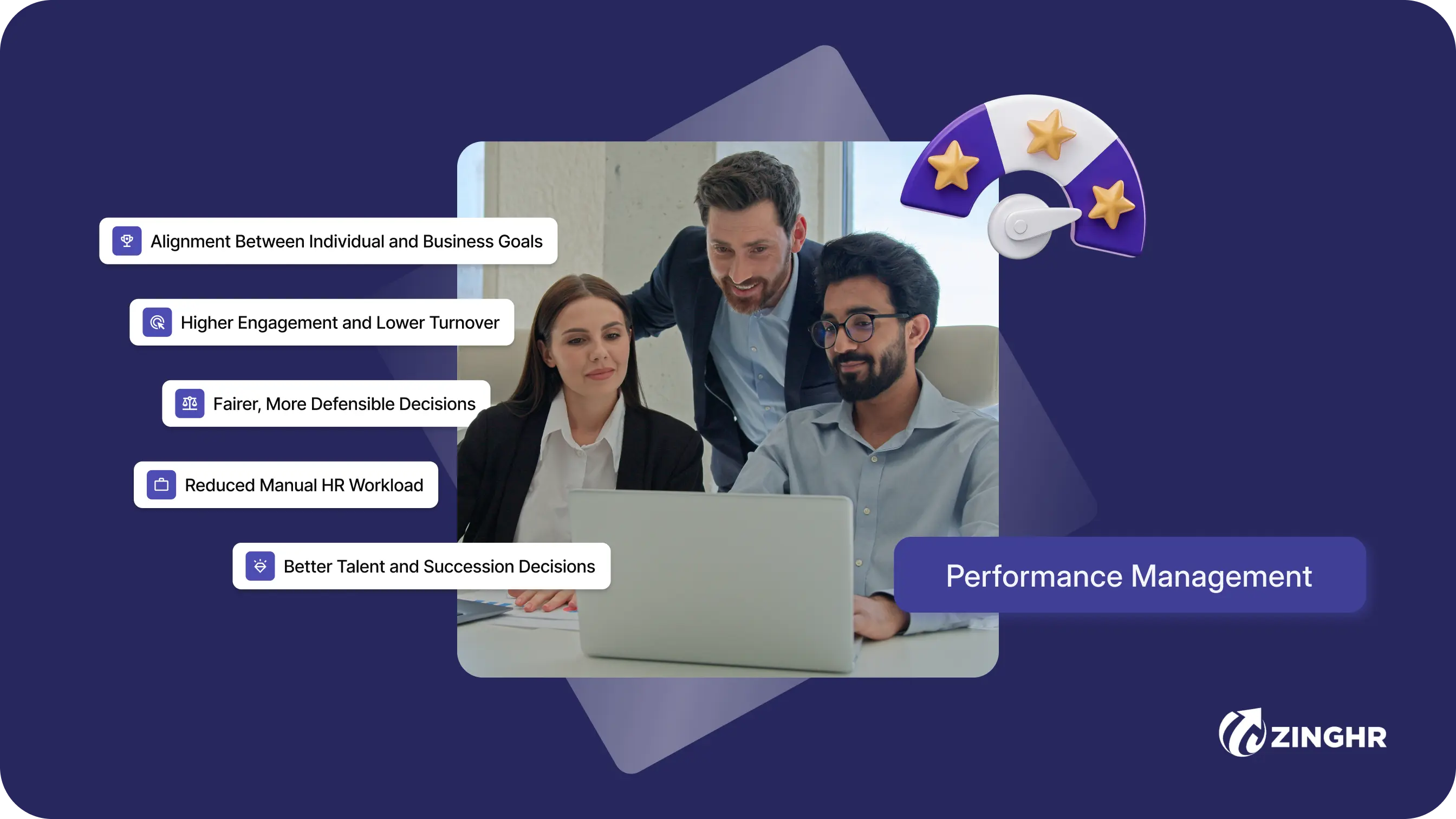
Table of contents
One unstitched HR platform to manage your entire workforce, from Hire to Re-Hire.
Talent Management solutions built for growing and exceptional people
Built-in compliance tools that update with changing regulations
Automated payroll, attendance, and leave management
Insights that help HR leaders make faster, better decisions

Key Takeaways
- A performance management process helps HR teams align employee goals with business priorities across departments, locations, and business units.
- Effective performance management requires continuous check-ins, structured evaluations, calibration and analytics, because annual reviews alone are not enough.
- AI-powered HCM platforms reduce manual HR coordination and improve fairness, visibility, and quality of decision-making.
- The six-stage cycle of goal setting, goal approval, continuous check-ins, evaluation, calibration and analytics, should be supported by role-based workflows and reporting.
- ZingHR connects goals, feedback, development plans, and performance insights in one unified Hire-to-ReHire HCM platform and single system of record and action.
For HR teams, the performance management process is the operating rhythm that connects business priorities with employee goals, manager feedback, development plans, and leadership visibility. When it works, individual and team performance move in the same direction as organisational strategy. When it breaks down, goals become inconsistent, reviews become subjective, and HR teams spend too much time managing spreadsheets, reminders, approvals, and reports.
Gallup's 2026 State of the Global Workplace found that only 20% of employees worldwide are engaged at work; a figure that has held stubbornly low despite significant investment in performance tools. The gap is rarely a technology problem. Fragmented systems, unclear performance expectations, and annual reviews that arrive too late to change outcomes are far more common culprits.
A structured, AI-enabled performance management program changes the equation. HR teams can configure goals, approvals, check-ins, evaluations, calibration, and analytics in one consistent workflow.
This guide explains how to set up a scalable performance management process and how an AI-powered HCM platform like ZingHR makes the whole cycle more consistent and grounded in real performance data.
The Performance Management Process: 6 Stages to Drive Outcomes
The performance management cycle runs continuously. Each stage feeds the next, and priorities shift fast enough that a once-a-year approach leaves too much uncorrected for too long. The table below summarises the six core stages, what each delivers, and where HR teams should focus.
Six key stages of an effective performance management framework
What is a Performance Management Process?
A performance management program works as an ongoing cycle:
- Goal setting: Define performance goals and expectations that are clear and measurable.
- Goal approval: Align individual and team objectives with business priorities.
- Continuous check-ins: Monitor progress in real time and catch risk early.
- Evaluation: Review employee performance and give constructive feedback.
- Calibration: Ensure performance assessments are consistent across business units.
- HR analytics: Turn performance data into decisions about development, succession and workforce planning.
How ZingHR Connects Performance Management to the Full Employee Lifecycle
Performance management should connect with recruitment, onboarding, learning, succession planning in HR, workforce planning, compensation, payroll, attendance and employee engagement.
ZingHR connects performance management with the broader employee lifecycle, from hiring and onboarding through learning, engagement, succession, workforce planning and rehire.
HR teams get one platform to manage goals, feedback, reviews, calibration, development plans, and analytics without relying on fragmented tools or manual coordination.
Set Up a Performance Management System in 6 Steps
Setting up an effective performance management process requires clear configuration decisions at each stage. With ZingHR's performance management capabilities, HR teams can configure goal templates, approval workflows, continuous check-ins, evaluation forms, calibration methods, and analytics dashboards in one connected HCM platform.
Step 1: Goal Setting
Goal setting is the planning stage of the performance management cycle, and it sets the conditions for everything that follows. Employees with clear, measurable performance goals know exactly what is expected of them. They have a roadmap that keeps day-to-day tasks connected to business objectives.
Three goal-setting methods work well:
1a. SMART Goals: Specific, Measurable, Achievable, Relevant, Time-bound
SMART goals replace vague direction with precision. "Increase sales" becomes "Increase Q4 sales revenue by 20% compared to Q3." Employees know the actual target and can structure their work around it rather than interpret it.
1b. Balanced Scorecard Method
This method balances four areas:
- Financial (profitability, revenue growth, cost control, ROI)
- Customer (satisfaction, retention, acquisition, brand perception)
- Internal Processes (efficiency, quality, innovation, operational improvements)
- Learning & Growth (skills, training, knowledge management, culture)
A marketing manager, for example, may hold a financial goal (increasing campaign ROI), a customer goal (increasing brand awareness across markets), an internal process goal (improving ad review turnaround), and a learning goal (completing a leadership course).
1c. KRA Method (Key Result Areas)
KRAs cover the broad areas of job responsibilities tied to a role. For an HR Manager, KRAs might include recruitment efficiency, training completion rate and employee engagement.
Step 2: Goal Approval
Setting goals and approving goals are different activities. Without approval workflows, teams can spend an entire quarter chasing objectives that do not connect to the organisation's strategic objectives.
Goal approval prevents that misalignment. It also creates the space for open conversations between managers and employees about what realistic performance expectations look like before the cycle starts.
A practical example: if a team member sets a performance goal of attending three conferences, a manager might approve two and add a measurable outcome: "generate at least 15 qualified leads from each event." The goal moves from activity to business impact.
Step 3: Continuous Check-ins
Annual reviews tell managers what went wrong after the fact. Continuous performance management changes the timeline. Regular check-ins act as early signals: when a goal goes off-track, managers see it while there is still time to intervene, and employees get timely feedback instead of a year-end surprise.
A regional sales manager with a quarterly target of AED 500,000 in new revenue is tracking at 40% of target halfway through the quarter. With a continuous performance management system, the reporting manager sees this on the dashboard and can intervene with coaching, pipeline support, or revised territory priorities.
Poor performance that goes unaddressed for months rarely improves on its own; monitoring progress in real time gives managers the window to change that.
.webp)
Step 4: Evaluation
Performance evaluations are often reduced to numbers on a page. A well-structured evaluation does more: it recognises what is working, surfaces what needs to change, and creates a plan for professional growth.
Effective evaluations cover four areas: manager evaluation (based on both KPIs and behaviours such as teamwork and leadership); self-evaluation (giving employees a voice and ownership of their development plans); a growth potential check (identifying people ready for larger roles); and development needs (targeted training and career development plans).
For example, an engineer might rate themselves highly on technical skills but flag low confidence in client presentations. That insight becomes an actionable development plan with communication training, smaller presentation opportunities and gradual confidence building.
Step 5: Calibration
Some managers are naturally generous; others set a higher bar. Left to personal judgement across dozens of departments, this creates rating inconsistencies that employees notice and resent. Calibration is how HR teams bring ratings into a defensible range.
If two employees in different departments deliver the same level of performance against the same business objectives, they should receive the same rating. Calibration removes the individual manager's judgement as the only variable.
Training managers on calibration methodology is as important as the technology used to run the session.
Step 6: HR Analytics and Reporting
Analytics is where the performance management program shifts from a compliance exercise into a real input for business strategy. Data across the full cycle, such as goal completion rates, check-in frequency, evaluation scores and calibration outcomes, becomes readable as a pattern.
HR teams can see which managers drive the highest employee engagement, which teams are at flight risk, and where skill gaps are clustering before they affect business outcomes.
Benefits of a Modern Performance Management Process
A well-designed performance management process changes what HR teams can see, decide, and act on. The benefits below apply across distributed workforces and regulated industries where consistency and fairness are non-negotiable.
1. Alignment Between Individual and Business Goals
A structured performance management process ensures every employee understands how their work connects to organisational objectives. At scale, that alignment prevents duplicated effort and keeps distributed teams working toward the same business priorities.
2. Higher Engagement and Lower Turnover
Regular feedback keeps employees engaged because their contributions are visible and their career development is supported. For HR operations leaders, lower turnover means lower replacement costs and stronger institutional knowledge across the workforce. These conditions make for a more fulfilling work environment for the employees who stay.
3. Fairer, More Defensible Decisions
Calibration and analytics remove subjectivity from ratings, promotions, and compensation. Engaged employees are more likely to trust a performance management system when they can see that ratings are consistent and grounded in actual performance data rather than individual manager preference.
This matters especially in regulated industries such as BFSI, pharma, and manufacturing, where audit trails and defensible decisions are a compliance requirement.
4. Reduced Manual HR Workload
Automating goal workflows, approvals, reminders and reporting frees HR teams from low-value coordination. Performance cycles become easier to manage, follow-ups happen automatically and managers spend less time chasing updates, allowing HR to focus on talent development and strategic workforce initiatives.
5. Better Talent and Succession Decisions
A structured performance management process gives organisations consistent performance data across teams, making it easier to identify high-potential employees, recognise skill gaps and plan internal mobility. HR leaders can make succession and promotion decisions based on measurable performance rather than subjective feedback.
Key Features of Modern Performance Management Software
The effectiveness of performance management software depends on the features it offers. Look for a platform that supports continuous performance management, simplifies evaluation cycles and gives managers the insights they need to develop, recognise and retain talent.
Here are the key features to prioritise:
1. Configurable Goal and Competency Templates
HR teams need to standardise performance management goals by role, department, business unit, or cycle. Configurable templates ensure consistency across locations while allowing for functional differences. It is essential for organisations operating across multiple countries or regulated markets.
Templates also reduce the time managers spend setting up evaluations from scratch each cycle.
2. Role-Based, Multi-Level Approval Workflows
Governance is non-negotiable. Role-based approval workflows route goals and evaluations to the right managers, HRBPs, and leaders, with full audit trails to support compliance in regulated industries.
Without them, HR teams have no reliable way to confirm that individual and team objectives have been reviewed and approved against strategic objectives.
3. Continuous Check-ins and Feedback
Modern performance management software should support ongoing feedback, not just annual performance appraisals.
Real-time dashboards, check-in history, and structured employee feedback capture ensure performance conversations are continuous, documented and connected to the evaluation that follows.
4. Calibration and 9-Box Talent Planning
Fair ratings depend on calibration tools, such as bell curve distribution, moderation meetings and the 9-box grid. These features standardise performance assessments across business units and feed directly into succession planning and leadership development pipelines.
5. AI-Powered Analytics and Reporting
AI-enabled dashboards turn performance evaluation data into decisions by surfacing trends, skill gaps, potential successors and rating inconsistencies across the full cycle. For regulated industries, transparent, analytics-backed reporting supports both fairness and auditability during internal reviews.
6. Integration Across the HCM Suite
Performance management software should connect to core HR, learning, succession, compensation, payroll and workforce planning.
Integration ensures performance data flows across every stage of the employee lifecycle, allowing organisations to link appraisal outcomes with development plans, promotion decisions, succession pipelines, compensation reviews and workforce planning without duplicate data entry or disconnected processes.
7. Data Security and Access Controls
Performance management software should protect sensitive employee and performance data through role-based access controls, encryption and comprehensive audit trails.
Granular permissions ensure employees, managers and HR teams can access only the information relevant to their roles, helping organisations maintain confidentiality, strengthen governance and meet internal compliance requirements.
.webp)
Why Choose ZingHR’s Performance Management Software?
ZingHR is an AI-powered HCM platform that reduces transactional HR work and unifies core HR, workforce management, talent management, automation and analytics in one system.
Leading organisations across the MEA region, including Teleperformance, Burjeel Holdings, SGS, and Shapoorji Pallonji, rely on ZingHR to streamline and scale performance management.
Its performance management capabilities enable HR teams to configure goal templates, approval workflows, continuous check-ins, evaluation forms, calibration methods and analytics dashboards within a single platform. That creates a consistent performance management process across business units while giving employees, managers, HR business partners and leadership access to one shared system of record.
Performance management is connected to the complete Hire-to-ReHire lifecycle, eliminating the need for fragmented tools, spreadsheets and email-based follow-ups. Goals, continuous feedback, development plans, calibration and workforce insights are managed from one platform, reducing manual coordination and giving leaders the visibility needed to make faster, more informed people decisions.
Build a Continuous Performance Management Strategy
An effective performance management process gives HR teams a structured way to set goals, capture continuous feedback, evaluate employee performance, calibrate ratings and turn workforce data into meaningful decisions.
Relying on annual appraisals, disconnected tools and manual reporting limits visibility and delays the conversations that drive employee growth and business performance.
ZingHR brings performance management into a connected Hire-to-ReHire lifecycle, helping HR teams reduce administrative effort, equip managers with better performance insights and support continuous employee development through one AI-powered HCM platform.
Book a demo to see how ZingHR can strengthen your performance management strategy.
Frequently asked questions (FAQs)
The six stages are goal setting, goal approval, continuous check-ins, evaluation, calibration, and HR analytics. Each stage should be supported by structured workflows, role-based access, automated reminders, and reporting so HR teams can manage individual and team performance consistently.
KRAs are the broad job responsibilities tied to a role; KPIs are the measurable results tied to those responsibilities. Together they give managers an objective basis for performance assessments and give employees a clear view of what completing their responsibilities well looks like.
Performance management strategies are structured approaches to improving organisational performance, including continuous feedback, development planning, calibration for fairness, AI-powered analytics, and governance across business units. Together they turn the performance management cycle from an annual formality into an ongoing process.
Look for configurable goal templates, multi-level approval workflows, continuous feedback tools, evaluation forms, calibration features, 9-box talent grids, analytics dashboards, data security controls, and integration with core HR, learning, succession, and workforce management. Integration is the most frequently overlooked requirement.
inconsistencies faster and with greater accuracy. Organisations using AI-enabled performance analytics are 2.3 times more likely to identify high-potential talent accurately than those relying on manual methods.
What to do next?
See ZingHR in Action
Join the 1,200+ enterprises that have replaced fragmented HR with one intelligent, future-ready platform. See ZingHR in 30 minutes.
Build the Organization You Want
Great HR drives retention, capability, and culture. ZingHR takes care of the operational layer so your people team owns the strategy.
Dr. Anupama Iyer
Director — HR
Dr. Anupama Iyer is Director — HR at ZingHR and an accomplished HR leader, consultant, facilitator, and academic with over two decades of experience in people practices and talent development. Her work spans HR consulting, training design, leadership development, and academia. Bringing both a practitioner's and an educator's perspective, she is passionate about building people-centric workplaces and helping organizations create cultures that enable growth, employee development, and long-term success.

Elevating Impact.
Defining Destiny
See how ZingHR's AI-powered Hire-to-ReHire platform frees your CPO to lead with purpose and deliver the outcomes your Board is watching for


ZingHR is the AI-powered Hire-to-ReHire platform built for one purpose to remove every transactional layer of HR from your organisation, permanently.